
The written case
We run the full exercise: data pack, analysis, slides, presentation, under time pressure. It is the stage candidates most often meet for the first time on the day.

The firm with the most unusual interview process in the region. How it recruits, what the written case involves, and where candidates lose the offer.
New to consulting in the region? Start with the complete guide.
Kearney was founded in 1926 by Andrew Thomas Kearney, who had been McKinsey's first partner before leaving to start his own practice. The firm marks its centenary in 2026. It dropped the A.T. from its name in 2019 and is partner-owned, with more than 5,300 people across 40 countries.
Five offices: Abu Dhabi, Beirut, Doha, Dubai and Riyadh. Most opened between 2006 and 2007, with Doha added in 2014. Dubai sits in DIFC, Riyadh in Al Faisaliah Tower, and Abu Dhabi in Capital Centre.
In 2023 Kearney made its first ever Middle East acquisition, buying Management Solutions Experts, a Lebanese firm of around 100 staff founded by former Booz & Company partners, specialising in strategy implementation. That deal signalled where the firm wants to compete: not just designing strategies but delivering them.
Four Gulf offices plus Beirut, giving the firm reach into the Levant that most competitors lack.
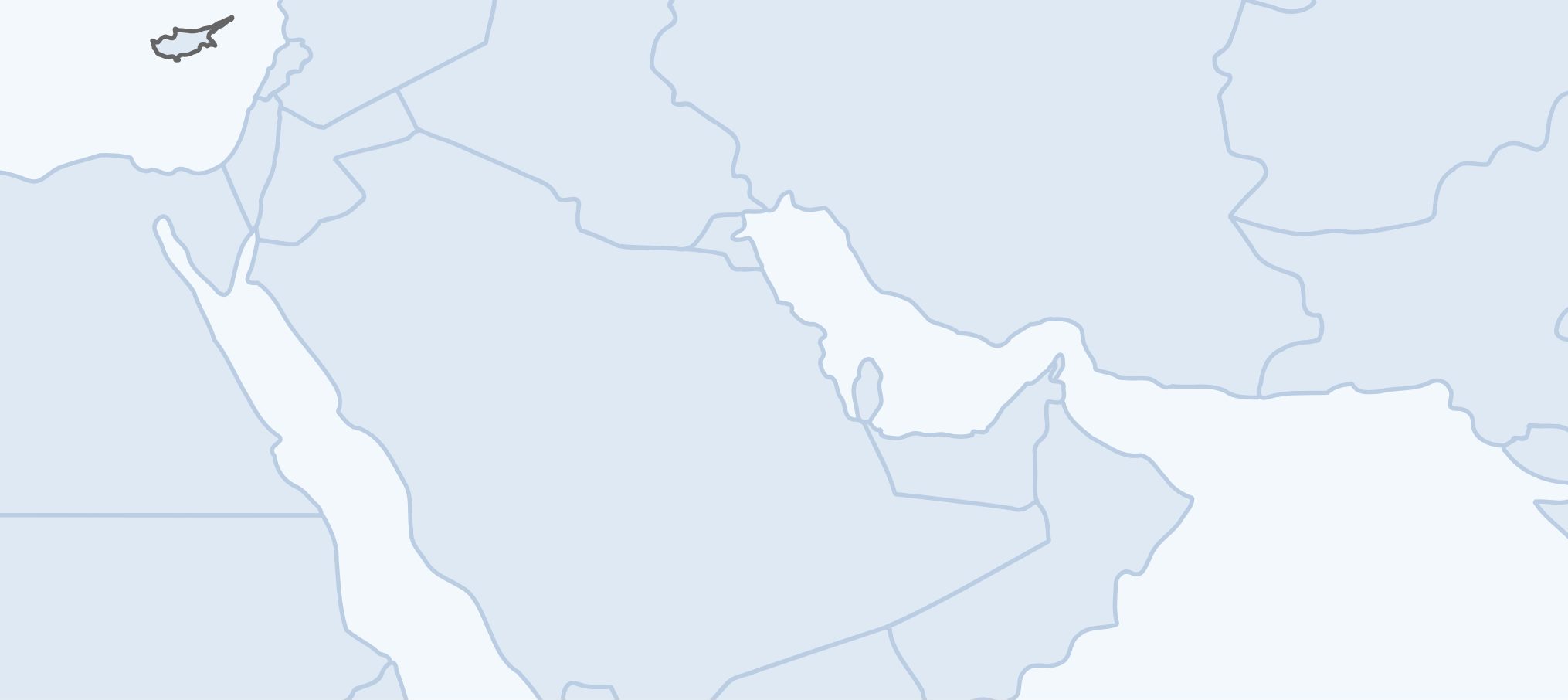
Base map: Wikimedia Commons, public domain.
Office locations and history are published by Kearney, which also reports more than 5,300 employees across 40 countries and clients across three-quarters of the Fortune Global 500. Regional employee headcount and revenue are market estimates: the firm does not disclose either. Headcount covers all staff in the region, not consulting staff alone.
Kearney's regional strength sits in public sector work, and the firm's global Public Sector practice is currently led by a partner who came out of the Middle East business. Defence and education are particular strengths here, alongside the operations and procurement heritage the firm has carried since its founding.
Where the firm is strongest here:
The firm also produces widely cited regional research including the Global Cities Index, the FDI Confidence Index and the Global Cities Resilience Index, and has launched a Middle East and Africa unit of Kearney Foresight, its strategic intelligence division.
Worth knowing before you network. A specific, informed approach to the right person beats a generic one every time.
| Role | Leadership | Focus |
|---|---|---|
| Middle East and Africa | Mauricio Zuazua, Region Chair | Regional leadership |
| United Arab Emirates | Adel Alfalasi, Partner and Managing Director | Government reform, national strategy, sovereign wealth |
Leadership changes. Check the firm's regional people page before you reach out.
Kearney expanded quickly through 2023 and has been resizing since, with a number of senior departures. Several went to FTI Consulting, which has been building aggressively in the region and appointed a former Kearney partner as head of its Middle East business. Kearney has continued hiring partners in parallel, including senior government-facing appointments in the UAE during 2025.
Kearney cases are candidate-led, as at BCG and Bain, and they lean quantitative. What changes in this region is the source material: because so much of the work is public sector, candidates report a much higher chance of an unstructured case drawn closely from a live project rather than a tidy commercial scenario.
Every interview also carries a fit component at the front. Candidates in Dubai consistently report three questions: why strategy consulting, why Kearney, and why this region. All three are screened seriously, and the third is the one candidates most often fumble.
| Level | What the level is | Typical time to next level |
|---|---|---|
| Business Analyst | Undergraduate entry | 1.5 to 2 years |
| Senior Business Analyst | Promotion from Business Analyst | 1 to 2 years |
| Associate | MBA and advanced degree entry | 2 to 3 years |
| Manager | Runs the team and the client day to day | 2 to 3 years |
| Principal | The level below partner | 3 to 5 years |
| Partner | Full ownership of accounts and practice areas |
On schedule, Business Analyst to Partner runs to roughly 10 to 14 years. Kearney is partner-owned and runs an up-or-out model. Titles vary slightly by office and practice.
In line with Oliver Wyman: around 5 to 10% above Bain at the early levels, converging to roughly the same at senior levels. Gulf packages are paid tax-free.
| Level | Total compensation, UAE offices |
|---|---|
| Business Analyst | AED 310,000 to 390,000 |
| Associate | AED 675,000 to 850,000 |
| Manager | AED 810,000 to 1,260,000 |
| Principal | AED 1,155,000 to 1,575,000 |
| Partner and above | AED 1,575,000 and above |
Senior Business Analyst sits between the levels shown and is paid accordingly. Packages include a performance bonus, housing allowance and health insurance on top of base.
Ranges reflect offers our candidates have received alongside market data. They vary by office, entry level and prior experience, so treat them as indicative rather than a quote.
We hold 31+ Kearney case prompts reported from interviews in this region, with a strong weighting toward public sector problems. They sit alongside 135+ cases and prompts across MBB and Tier 2, with Win Guides covering structuring and fit.
Our coaches are ex-MBB Senior Managers and Associate Partners who led interviewing and recruiting for their firms in this region.
We run the full exercise: data pack, analysis, slides, presentation, under time pressure. It is the stage candidates most often meet for the first time on the day.
Forty questions in sixty minutes with no calculator is a speed problem, not a difficulty problem. We drill mental arithmetic until it stops being the bottleneck.
Unstructured problems drawn from real government work, so you learn to impose structure where a textbook framework does not fit.
Some offices do. Candidates report a timed recruitment test of around 40 GMAT-style questions in 60 minutes covering quantitative and verbal reasoning, with no calculator allowed. A few offices add a short Excel test for certain roles. Confirm with your recruiter which apply to you.
A stage most firms do not use. You are given data and background, prepare an analysis and build slides, then present your findings. Undergraduates often do this as a group exercise; MBA and experienced hires typically do it individually.
Candidate-led, like BCG and Bain. In this region candidates also report a higher chance of an unstructured case drawn closely from a real project, particularly in public sector work.
Because it is a genuine screen. Candidates in Dubai consistently report three motivational questions: why strategy consulting, why Kearney, and why this region. All three need specific answers.
The firm expanded quickly through 2023 and has been resizing since, with a number of senior departures. Several went to FTI Consulting, which appointed a former Kearney partner as head of its Middle East business. Kearney has continued hiring partners in parallel, including senior government-facing hires in the UAE.
A free 30-minute call, a clear diagnosis, and a plan. Nothing to pay until you decide to continue.