
PEI depth
We stress-test your stories until they hold up under the questioning McKinsey actually applies, including the parts of your background that are not on your CV.

How the firm recruits here, what the interviews are actually like, what the job pays, and where candidates lose the offer.
New to consulting in the region? Start with the complete guide.
McKinsey has worked in this region since 1957 and now runs eight offices across it. For candidates, this is one of the most active recruiting markets the firm has anywhere.
Abu Dhabi, Cairo, Doha, Dubai, Karachi, Kuwait, Manama and Riyadh. Riyadh and Dubai carry the heaviest project load, driven by government transformation work and Vision 2030 programmes. Consultants staff across borders rather than staying in one city, so flexibility on location helps your application rather than hurting it.
Abu Dhabi, Cairo, Doha, Dubai, Karachi, Kuwait, Manama and Riyadh.
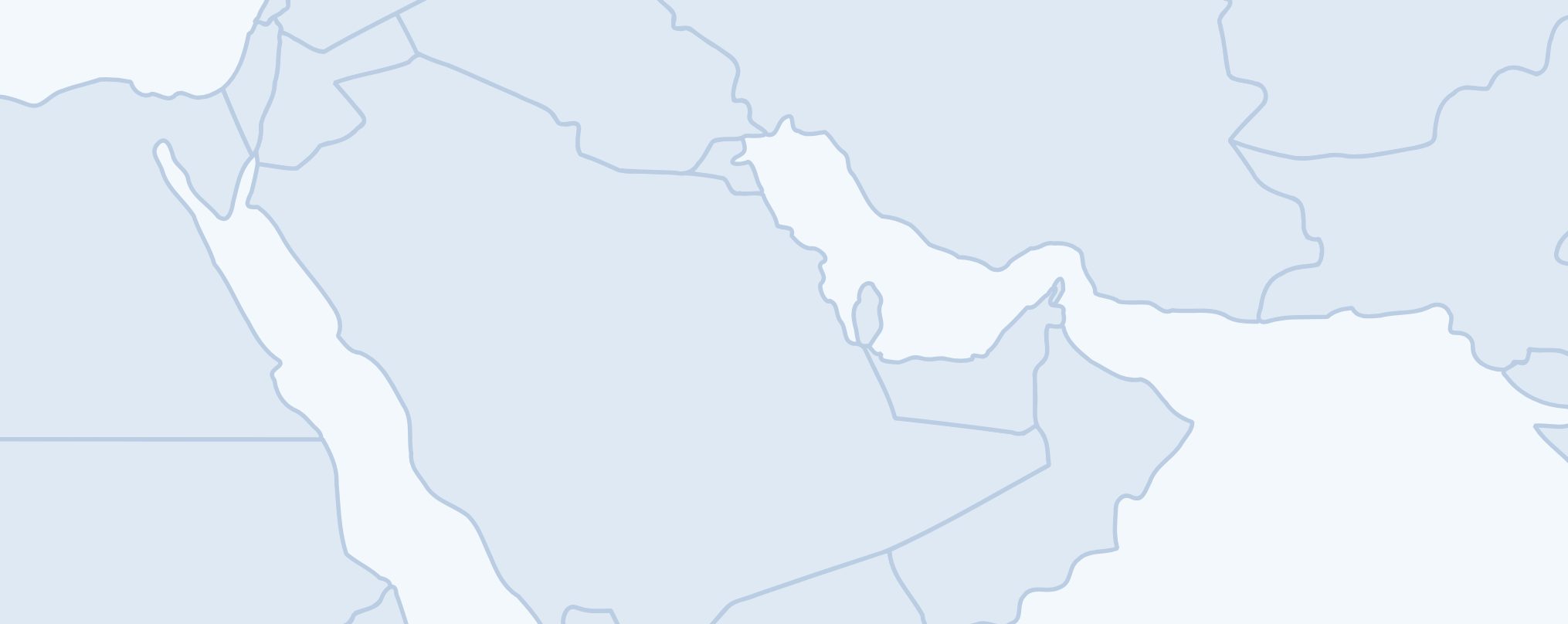
Riyadh and Dubai, highlighted, carry the heaviest project load. Base map: Wikimedia Commons, public domain.
Offices, nationalities and the firm's history in the region are published by McKinsey. Employee headcount and revenue are market estimates: the firm does not disclose either. Headcount covers all staff in the region, not consulting staff alone. Growth is concentrated in Saudi Arabia, where Vision 2030 programmes drive the largest share of public sector work.
McKinsey pioneered the national vision model here and has worked on transformation programmes across Saudi Arabia, Dubai, Bahrain, Kuwait and Lebanon among others. That history is the firm's defining regional asset and still shapes the work it wins.
Where the firm is strongest here:
This matters more than candidates expect. McKinsey runs flat structures with small on-the-ground teams, heavy involvement from senior experts and grey-hair advisors, and a substantial background network supporting research, analytics and slide production.
These are engagements that have been publicly reported or that the firm itself publicises. They are a useful guide to the kind of work you would actually be staffed on.
The firm also runs regional talent programmes including Qiyada Emerging Leaders and the Abu Dhabi Leadership Development Programme, which are worth knowing about if you are a GCC national.
Worth knowing before you network. McKinsey publishes its regional leadership, and a specific, informed approach to the right person beats a generic one every time.
| Office | Leadership | Focus |
|---|---|---|
| Abu Dhabi | Rima Assi, Senior Partner and Managing Partner | Public finance and investments |
| Riyadh | Tarek El Sayed, Senior Partner and Managing Partner | CEOs, senior executives and government leaders |
| Doha | Samvit Kanoria, Senior Partner and Managing Partner Qatar | Real estate and infrastructure, institutional investors |
Leadership changes. Check the firm's regional people page before you reach out.
This is where candidates get caught out. At McKinsey, interviewers have the freedom to design and run their own cases, built from real projects they have delivered. There is no central bank of approved cases they are required to work from.
What that means in the room:
The three MBB firms sit on a spectrum here, and preparing for all of them with a single approach is the most common preparation mistake we see.
| Firm | Where the case comes from |
|---|---|
| McKinsey | Interviewers design their own from real projects, with no central approval |
| BCG | Interviewers bring their own, but each must be approved by the talent committee |
| Bain | A database of pre-approved cases, reviewed for consistent style and difficulty |
The personal experience interview carries real weight at McKinsey, and candidates consistently under-prepare it.
Be ready to go very deep on your experiences, including things that are not on your CV. The questioning does not stop at what you did. It goes to why you did it, what you were thinking at the time, what you would do differently, and what it says about you.
Worth knowing before you apply. After several years of very heavy spending, Saudi Arabia has begun prioritising outlays and has pulled back on consulting spend. Bloomberg reported in 2026 that business from PIF was down sharply across the major firms, though none has been shut out and work around the giga-projects continues.
| Level | What the level is | Typical time to next level |
|---|---|---|
| Business Analyst | Undergraduates | 2 to 3 years |
| Junior Associate | BAs continuing, or Masters hires | 1 to 2 years |
| Associate | MBA and advanced degree hires, experienced hires | 2 to 3 years |
| Engagement Manager | Runs the team and the client day to day | 2 to 3 years |
| Associate Partner | Owns client relationships, starts selling | 3 to 4 years |
| Partner | Full ownership of accounts and practice areas | |
| Senior Partner | Firm leadership |
On schedule, Business Analyst to Partner runs to roughly 10 to 15 years depending on entry point and pace. Most Business Analysts leave for an MBA or another role before Associate, and returning after an MBA is a common and well-supported path. Promotion is up-or-out: you either progress on schedule or you leave.
Gulf packages are paid tax-free, which is the single biggest difference from London or New York. A headline number that looks similar on paper leaves considerably more in your account.
| Level | Total compensation, UAE offices |
|---|---|
| Business Analyst | AED 275,000 to 345,000 |
| Associate | AED 600,000 to 750,000 |
| Engagement Manager | AED 770,000 to 1,200,000 |
| Associate Partner | AED 1,100,000 to 1,500,000 |
| Partner and Senior Partner | AED 1,500,000 and above |
At Partner level there is no meaningful ceiling. Compensation is driven by firm performance and by what you personally sell, so the spread between partners in the same office is wide.
Packages typically include a performance bonus, housing allowance and health insurance on top of base.
Ranges reflect offers our candidates have received alongside market data. They vary by office, entry level and prior experience, so treat them as indicative rather than a quote.
We hold 8+ full McKinsey cases reported from interviews in this region, with exhibits, model answers and scoring guidance, written in the firm's own format. They sit alongside 135+ cases and prompts across MBB and Tier 2.
Our coaches are ex-MBB Senior Managers and Associate Partners who led interviewing and recruiting for their firms in this region.
We stress-test your stories until they hold up under the questioning McKinsey actually applies, including the parts of your background that are not on your CV.
Mock interviews run the way McKinsey runs them: interjections, redirections, and pressure applied mid-thought rather than a clean walk through the steps.
We hold the screening scorecards. Your CV is written backwards from how it will be scored, which is where most candidates are cut.
No. English is the working language across the offices. Arabic is a genuine advantage on public sector work and helps an application stand out, particularly for Saudi-based roles, but it is not a requirement.
Yes. Solve is part of the process here as it is globally, and it sits between the CV screen and the first round of interviews.
McKinsey interviewers design their own cases from projects they have delivered, so the case runs as a discussion with frequent interjections rather than a clean sequence of steps. Bain works from a database of pre-approved cases reviewed for consistent style and difficulty. Preparing for both firms the same way is a mistake.
Riyadh and Dubai carry the heaviest project load. Consultants staff across borders rather than staying in one city, so flexibility on location helps your application rather than hurting it.
Yes, Riyadh packages typically carry a premium over Dubai at the same level.
A free 30-minute call, a clear diagnosis, and a plan. Nothing to pay until you decide to continue.